
A play about perception
In the second part of this interview, we will be discovering more behind the scenes of Bathtub, a unique play.
Thank you to Chloe Britain and Anoushay Dar for your heartfelt words. Thank you to all the team, Polly Virgoe, Diya Sengupta, Fai Banks, Connie Locker and Freya Carey-Wood, for your wonderful work.
This is one of those stories which must be seen, talked about and shared.
You worked on this project alongside other amazing creatives (Fai as marketing designer, Diya as dramaturg, Polly as producer, Connie and Freya as tech), how important was this collaboration?
A = Oh, so important and so exciting! I loved working with every single person. I’m so grateful that Chloe brought us together as a team, she created such a welcoming and collaborative workplace. It was fun and full of joy because everyone wanted the same thing: to share the story and to be honest with each other. I hope the audience felt seen and could relate with the play. In order to achieve that, the collaboration was essential. When we had Diya in the room, her thoughts were very useful and they helped us reflect upon questions such as: “What are we missing? What should we add to flash out specific scenes?”. Polly was fantastic in grounding our vision and in guiding us through the story we wanted to tell. Fai was perfect from the beginning and we loved the photos they took for our Instagram profile. When we worked on sound and lighting with Connie and Freya, it was great to hear their opinions on how to put the tech into the show. Everyone was vital to create the play that you saw in the end.
C = The whole team was handpicked. They were all the best people that I could have possibly worked with. To be honest, I was absolutely blown away that everyone said yes. It was such a strong team and I’m very grateful that everyone joined.

Throughout the play, you give your back to the audience when looking in the mirror. Usually this would be “forbidden”. It felt as if you wanted to create some privacy for the character, whose intrinsic destiny is to live on a stage, the least private space ever. Why?
A = We didn’t know we were going to have one mirror. Originally, we were going to have loads of them. Even though the stage was massive and people were looking, it was such a focused moment. I realised wherever an audience member sat, they would have a different vision of the mirror and a different perception of the character as well. That’s exactly what we wanted: multiple perspectives.
At a certain point, the character covers her face with red. Who chose it? What’s your take on it?
C = There had to be that moment of shock for the audience. I could only get some of the paint off, so then it stained. Especially at the beginning, the play is quite light-hearted, funny and sarcastic, so later there must be an indication of the fact that Ro is really struggling mentally. Ro has a lot of internal struggles that aren’t necessarily shown by her quick humour. In that moment those insights start to come out visually through the face.

This is a one-woman show. How did you learn to portray different characters? Why did you use the voice-over only for the mother?
C = I feel like I settled quickly into Ro. At first, during rehearsals, I was struggling and asking myself: “How can I play many characters at once?”. Then Shay came up with the fabulous idea of staying in one character’s physicality, but having dialogue between two characters. The character I “stayed” in changed depending on the direction of the scene. That was very helpful in terms of me as an actor being able to develop all the characters. Otherwise, the show would feel disjointed and not fluent. It’s important to remember that we are in Ro’s head, in her bathroom, in her space. Ro is the one reliving past situations in her head, but it was still important to make the characterisation of the other characters really clear. In a similar way, she’s not reliving the time with her mom, who is speaking through the bathroom door in the present. The mom’s voice is the only thing that penetrates the space, everything else is in her head.
In the end, we hear a thud and the mother’s worried voice and we see the lights turning off. But then the character appears again doing a sort of inner and mystical dance. Do you want to explain the finale or leave a cliffhanger?
A = We wanted it to be abstract.
C = It can be interpreted how the audience wants to. The stage direction is: “Ro finally has the moment with Elle. There is no reason to hide. It is perfect”.

There’s a lot of physical movement, how did you use it to stage the show?
C = Aside from using it to express the different characters, I always wanted to include many music-led physical moments in the show, especially at the beginning. When there are those movements, the audience can “be” with the character and experience her time in the bath. I don’t think you could get it through dialogue.
A = It allows a different kind of attachment to the scene. The movement does it in a different way from the dialogue. Every movement has intention.
Was it difficult to find an actual bathtub?
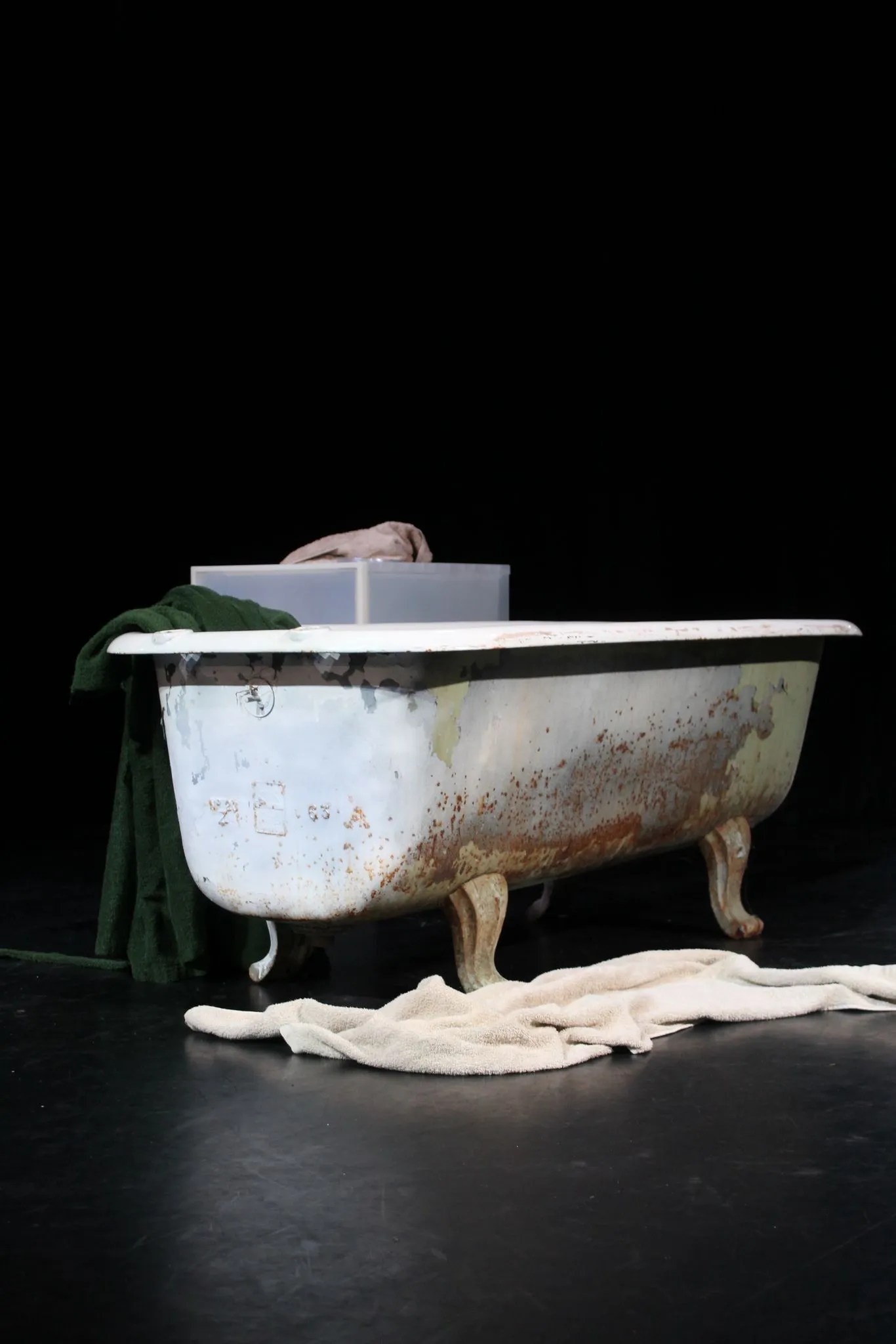
C = That was probably the most difficult part of the whole process. It was so heavy… It took at least four people to carry it. We had to pay for the cost of moving the bath from our house in Leamington Spa to campus, which was expensive. In the future, we’ll be looking for cheaper and lighter versions. But it was such a perfect and iconic bath!
If you feel like sharing them, what are your future projects?
C = I don’t have any specific projects happening right now. I’m going into the world of acting and writing, so I will likely be at the hands of other people’s projects.
A = Mines are similar. I’ll go into the world and see what happens. I’m hoping to get my works submitted.
What was you dream when you were little? And now?
C = Mine genuinely hasn’t changed. I’ve always wanted to do performing, I still want to do performing and I am doing performing – that is nice! When I was three, I wanted to be a dancer. By the age of ten, I wanted to do acting.
A = I wanted to be a writer, now it has developed into an all-round: writing, acting and being a creator.
Anna Baracco

 The Password