
In this essay, let’s dive into the mesmerizing world of Ice and Fire, a series created by George R. R. Martin, as well as have a look at a modern problem: how film criticism and cinephilia interact with long form streaming series.
Seriephilia is a modern counterpart to cinephilia. In contrast to cinema lovers, who are obsessed with auteur theory or genres, series buffs enjoy the proximity to a fictional reality; they love waiting for the next instalment to unveil more. Contemporary criticism tends to ignore this, simply equating a series to a “long film.” For many critics, there is no greater privilege for a show than to be called “auteur television.” Even some cinephiles make dismissive remarks towards our topic, such as: “Well, it is just six episodes; it could have been a film.”
We will not go down that road. In this piece, we are going to elaborate on the series in general but also on each episode in particular. That is why this is the first part of a two-part essay: it follows the logic of a series to separate events, making it easier to visually understand the topic.
In the first episode, we get to know our main character, Duncan the Tall, who will either gets his “Ser” nomination or not. After burying his old Ser, he sits down to rest. It is actually suggested by the camera and personal POV, with a long glance at the old knight’s sword, that he was not knighted. Since Duncan was his squire, it seems the old man might not have had the time or will to officially knight him. His past plays a big role in his character, and cinema is a beautiful art form to transmit this. We never actually see the “happiest day of his life”, when he became a knight; we see only the burial ceremony and the contradictory images of what he says about his old master.
Let’s also expand on the topic of spoilers. In a series, they are enemy number one, especially in those adapting literary pieces. In this article, everything that is said is based only on watching the series, unrelated to any reading of the books. However, by watching Game of Thrones (GOT) and House of the Dragon (HOTD) for the past ten years, alongside countless YouTube videos explaining and expanding on the world of Ice and Fire, we have all lived in this world for years already. This independence of the series from the books changes the discourse about the art piece that each episode represents.
For example, in a tavern at night, we meet two Targaryens. We just see them — drunk, with silver hair — and as viewers we know our Targaryen when we see one. The odd tension of the first three episodes that leads to the final revelation that Egg is, in fact, a Targaryen, is a classical Hitchcockian “bomb under the table.” We know it is going to happen sooner or later, we just wait. In that waiting, the tension and excitement rise. We concentrate on Ser Duncan and his struggles instead of just Egg’s origin. The author of the series beautifully uses the “infinite picture” of the universe in our heads to explain things in this smaller, visual universe.
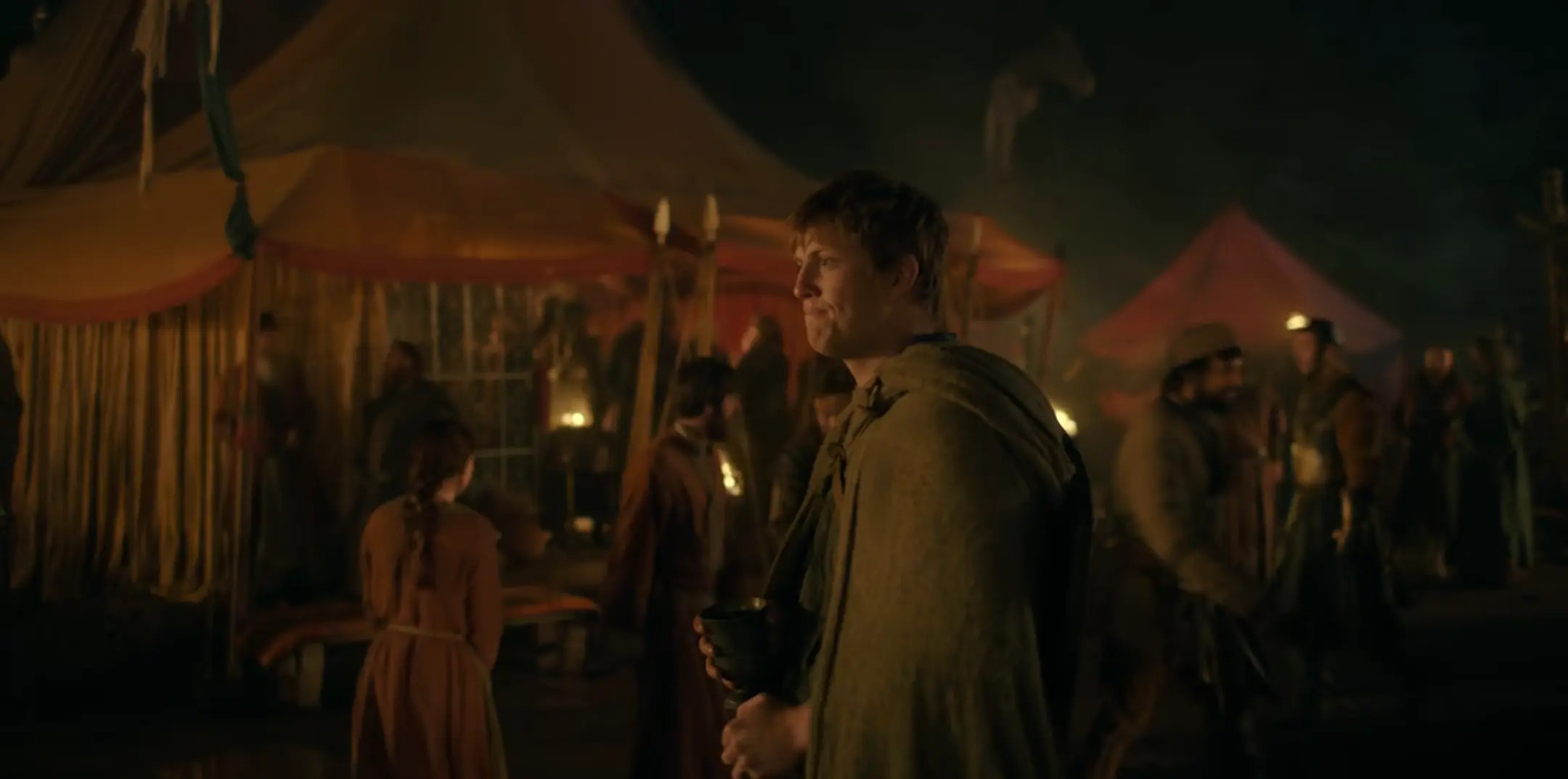
One episode represents one day of the tourney life. It circles from breakfast — which has, in the meantime, become a phenomenon in internet discussions — to night parties or theatrical shows. Ser Duncan is so relatable: between food and his struggles for money, it is just easy to fall in love with him. All the big names like the Targaryens and the Baratheons are in the background. Instead of torturing us with family trees and the infinite dialogues of HOTD, where one is simply lost in “whose uncle is whose father,” A Knight of the Seven Kingdoms concentrates on Duncan. Everything else is optional reading, and people read it eagerly! We discuss who is whose grandparent just because it is allowed, not because it is necessary. To Ser Duncan, as for us, it doesn’t matter — at least for the first three episodes.
On the technical side, one might want to expand on the cinematography. This is a dangerous path, as it might lead to a “legitimisation” of the series through a comparison to “Great Cinema.” A reverse example: in AKOTSK, night scenes are so beautifully made that films like The King (starring Timothée Chalamet) look dull and sad in comparison. The Middle Ages were anything but dull, they were colourful, and especially so were the fantastic “not-so-middle” ages of Ice and Fire. Every scene, especially at night, is vibrant and well-created. The famous party scene is just full of life.
This series does well in showing the fun that tournaments actually are and were, as far as the first three episodes are concerned. Let’s see where it leads us and discuss it in the process.
Viktor Smolkin

 The Password