
Ser Duncan and Egg continue their adventures as we continue with the second part of our analysis. The cultural phenomenon goes on with the last three episodes occupied by a Trial of Seven — a consequence of Ser Duncan smashing Prince Aerion’s face. This is an old tradition brought to Westeros by the Andals, who crossed the sea and brought their seven gods with them. It is a trial that requires a battle of 7 vs 7 knights. The series provides us with the tension before the match through the search for teammates, as well as the match itself and the aftermath. Let’s see how the tension builds up.
Ser Duncan (Peter Claffey) continues to be the internet’s favorite character for the past month. From hilariously assuming he must fight seven men against one, to his silent refusal to knight Raymun — as was discussed in the previous article, it is not clear whether he is a knight himself; therefore, he might not want to falsely knight others as he did himself. His fame might only be in competition with two other men: Prince Baelor (Bertie Carvel) and Ser Lyonel (Daniel Ings). The hype around these three on the internet is explained by the nature of their well-written characters. Ser Duncan and his everyday struggles to get food and clothes make him relatable and prone to becoming the foundation of memes like ‘how this email finds me’. Prince Baelor is a perfect example of a character loved by seriephiles who prematurely dies at his peak. In this case, however, fans who read the book were among us: therefore, the masochistic pleasure we received from the character’s death was somewhat anticipated and prepared for. Then there is Ser Lyonel, whose looks and charisma make him unbelievable on screen.
Partly, this is due to the cast: no doubt the actors play one of the defining roles in this success. We discussed in the previous part of the article how well the creators of the series used the wider world of Ice and Fire. However well-written and perfectly adaptable to the series format the book was, substantial work had to be done to utilize those qualities and transfer them to the screen. Take the characters, for example. Taking on the discussion of seriephilia, these fighters on the screen go far beyond the screen itself. What cinema does to a character perceived by the viewer extends outside of the screen, precisely because the viewer plays a crucial role in perceiving and co-creating the character. The number of people discussing how insanely cool and “goated” Prince Baelor is goes far beyond any hype the book might have ever wished for its character. Everyone tends to discuss them, and that is what makes them so important; that is what elevates the kindness, bravery, and hopefulness — the fact that everyone is suddenly talking about how cool it is that Ser Duncan saved Tanselle. It is just something that mass-consumed art does: it elevates the art to the peak of its abilities to interact with people.
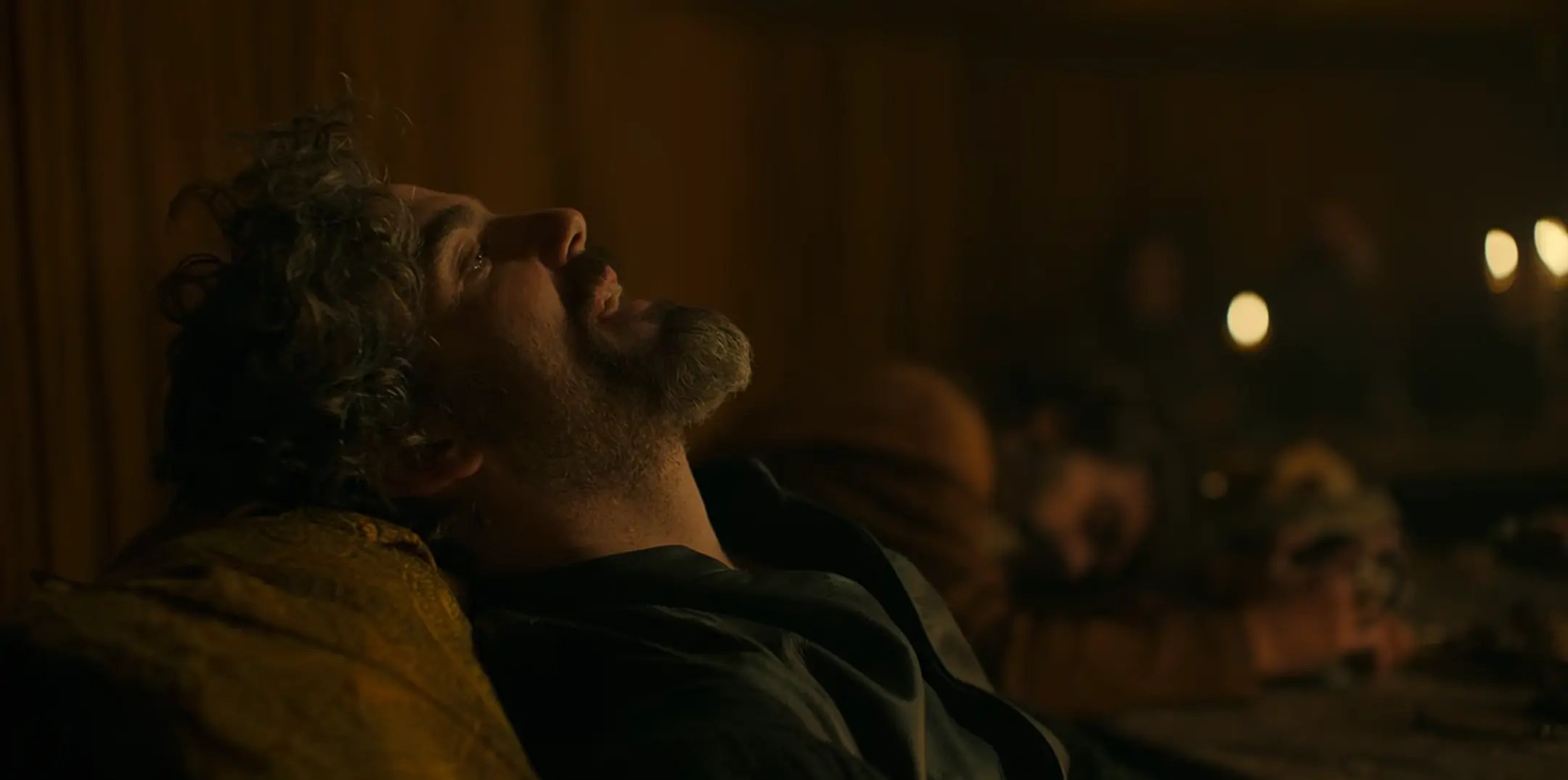
The fifth episode was widely discussed regarding its great cinematography. Following this, let’s examine the last two episodes together. There is a great use of lighting to save on the tight budget, but that’s definitely far from our perception of the fight. The “fog of war,” as it is sometimes called, presents a great opportunity for the visual art of cinema to visually introduce the idea of confusion and sporadic events. In the last episode, however, the use of light shifts to help establish the overall emotional depression. For example, it presents backlight in a scene with Ser Duncan and Prince Maekar to emphasise the moment of disagreement. Adding to that is the very rough editing, which contrasts with the fifth episode, where it was used in a battle scene to increase the dramatic effect. In the last episode, rough cuts serve to throw us out of our comfort zone. Such are the cuts from the initial (and sadly, the last for the year) scene with Ser Lyonel to the funerals. This lets us know that the next episode is important, throwing us in without preparation.
Overall, the last episode is a kind of farewell: everyone is saying goodbye, and we feel that the tournament has finished. It is cleverly and bravely crafted to introduce the ghost of Ser Arlan in the last frame. It does this by introducing parallel editing throughout the whole episode — almost an extra-diegetic intellectual montage that, yes, is explained by the nature of a flashback, but does not fulfill the same role. It does not amplify our knowledge of the character, but rather has a narrative function. Those sequences of Ser Arlan telling a story and dying a few times not only allow us to better understand the psychology behind Duncan’s decisions, but also prepare us for the last scene, where Duncan finally separates from his past (his master, Ser Arlan) and goes his own way. Only cinema can leave such an impression in such a beautiful way, and better yet, only a 6-episode series could do it.
Smolkin Viktor

 The Password