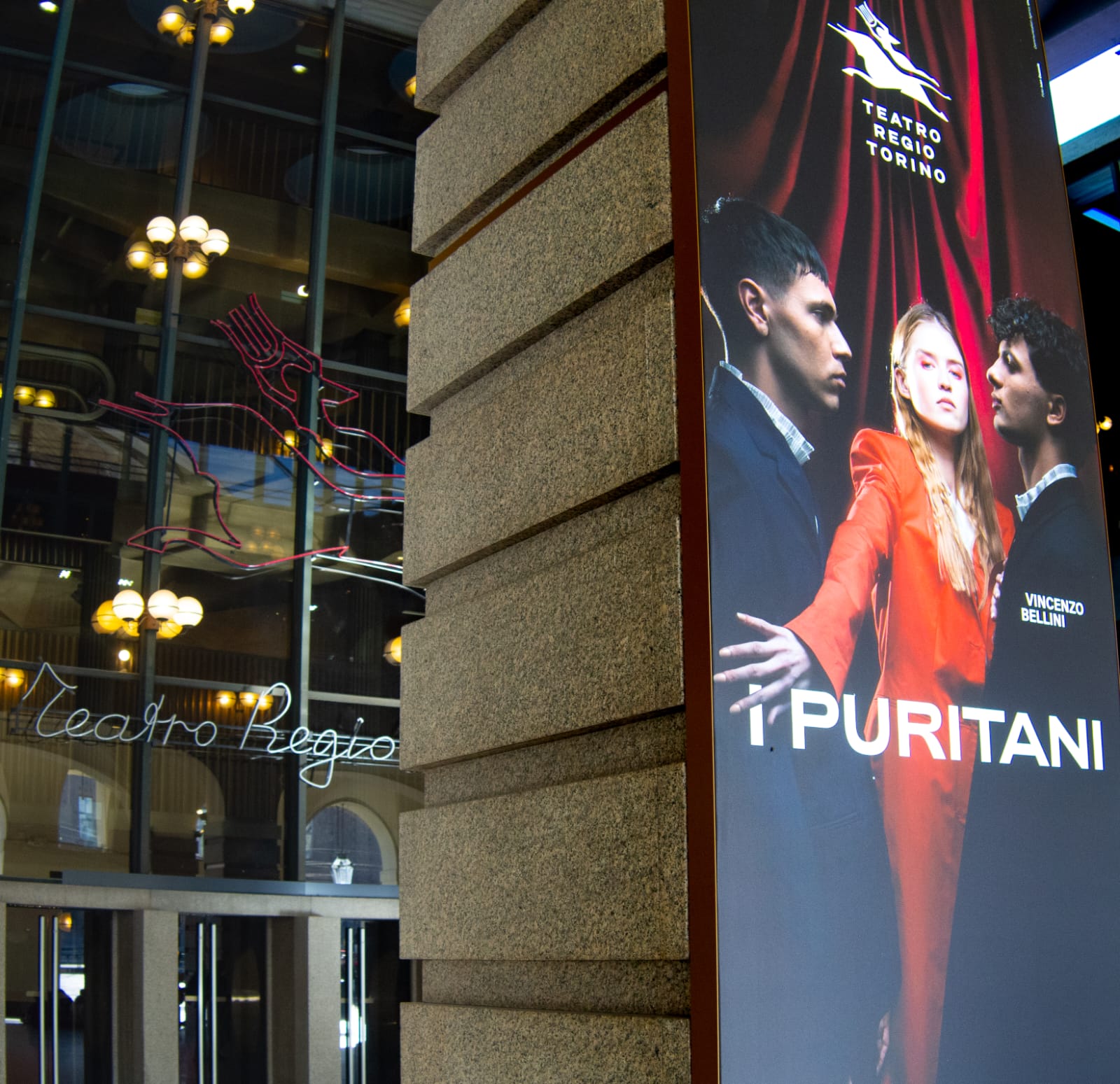
“No King” protests that unexpectedly became relevant in late 2025 have found their way into the global discussion on politics. Art, as an ultimate mediator between head and hands, always was and always is sensitive to the world around it. No one lives in a vacuum. Artists tend to help us mediate the world around ourselves, as viewers. Unexpectedly, two Italian men, Bellini and Pepoli, presented I puritani to the world in Paris on January 24, 1835. How can an almost 200-year-old lyric opera suit our interests in 2026? It seems that people tend to repeat themselves.
Originally, in 1835, I puritani was set during the English Civil War of the 1640s; it is a story of Parliamentarists trying to overthrow the monarchist government in their country. The key arias of the evening feature phrases such as “bello è morir per la libertà” or “fur tre secoli d’orror!”. Our adaptation in Turin, brought to light by Pierre-Emmanuel Rousseau and his team, sets the opera in the 19th century — contemporary to its creation. In effect, many art pieces are set in the past with respect to their viewers. Reasons vary from it being easier to criticize modernity under hard censorship, to the possibility of alienating the viewer to let them see events “historically” and therefore analyze them as something more “important” than their everyday lives. And as a matter of fact, for us living in 2026, both the 1800s and the 1650s are the past. Whatever the intent is, I puritani breathes the air of the 19th century — a time when the passions of revolutions brought to people an understanding of their importance as individuals; a time when a person becomes more important than history itself. Rousseau’s latest adaptation aims to highlight this notion.
Actually, this opera does not have a rigid plot — an absurd idea if one thinks of opera nowadays. It is basically rigid lines (which cannot be changed because they need to be sung) and music pacing (unchangeable because we are not Bellini). However, you’d better look into this text as a series of paintings or acts, each one of which is read as an expression of a passion rather than a plot line. For example, the main accent by the director is placed on “bigger than woman” emotions with a reference to Sturm und Drang literature, specifically in the character of Elvira, amazingly played by Gilda Fiume.
Notably, the opera starts with a non-linear passage of Elvira having a glimpse of her own future. It is a possibility for the director to introduce to us to his own interpretation of the opera. This symbolistic passage captures our attention and shifts the focus to Elvira and her torment. Showing his brilliance, Rousseau is also able to control the action and the space to expose the inner state of the character. Elvira is positioned cleverly inside decorations, such as a room of ancient female statues with faces cancelled out with red paint, or being pushed against a wall by the impressive amount of extras and the choir, which restricts both her physical and psychological space.
What becomes clear as well within the crowded scenes is the use of “close-ups” in theatrical scenes. An overall tendency toward cinema references, heated by the ultra-wide format of the stage itself, is explicit in different aspects of the directorial work. For example, moving backgrounds and the rooms simulate a reference to camera movement inside our brains. Furthermore, the impressive scene where Elvira attacks the crowd and begins to interact with the extras one by one gives us not only an idea of chaos and passion, but also a closer look at her emotions, usually evoked by a real close-up in cinema.
To continue on the topic of cinematic references, the decorations and the costumes serve as another interesting inspiration for analysis. Dark, gloomy environments and costumes at the start soon turn into crazy, bigger-than-life moving objects that act by themselves. Just like in Nosferatu (choose your director) or Faust by Sokurov, the decorations become characters on their own. From immense, alienating, empty spaces, they turn into active participants in the revolution happening on stage. Subtle changes, like two chandeliers that first move around and then are broken, or parts of the set being replaced by worn-out copies of themselves — all these details give us a glimpse of the immense work done backstage.
In the end, the beautiful last touch is the closing sequence realized on the scene of Teatro Regio. Arturo, the crush of Elvira, gets shot in the back quite unexpectedly. Then follows the scene of the last aria, and even though the 19th-century deus ex machina arrives and saves everyone, just before the very closure of the curtain, it seems that they both die. It is very alluding to another famous death in art: Belmondo and his long, long wald at the end of Breathless. It is a beautiful conclusion — death before something new, before a revolution that succeeds. The ultimate heroic death in art.
It’s worth seeing I puritani at Teatro Regio this Wednesday, Friday, and Sunday.
Viktor Smolkin


Lascia un commento